

E-Invoice Deadline: Why Malaysian Retailers Are About to Make Their Second Expensive Tech Mistake
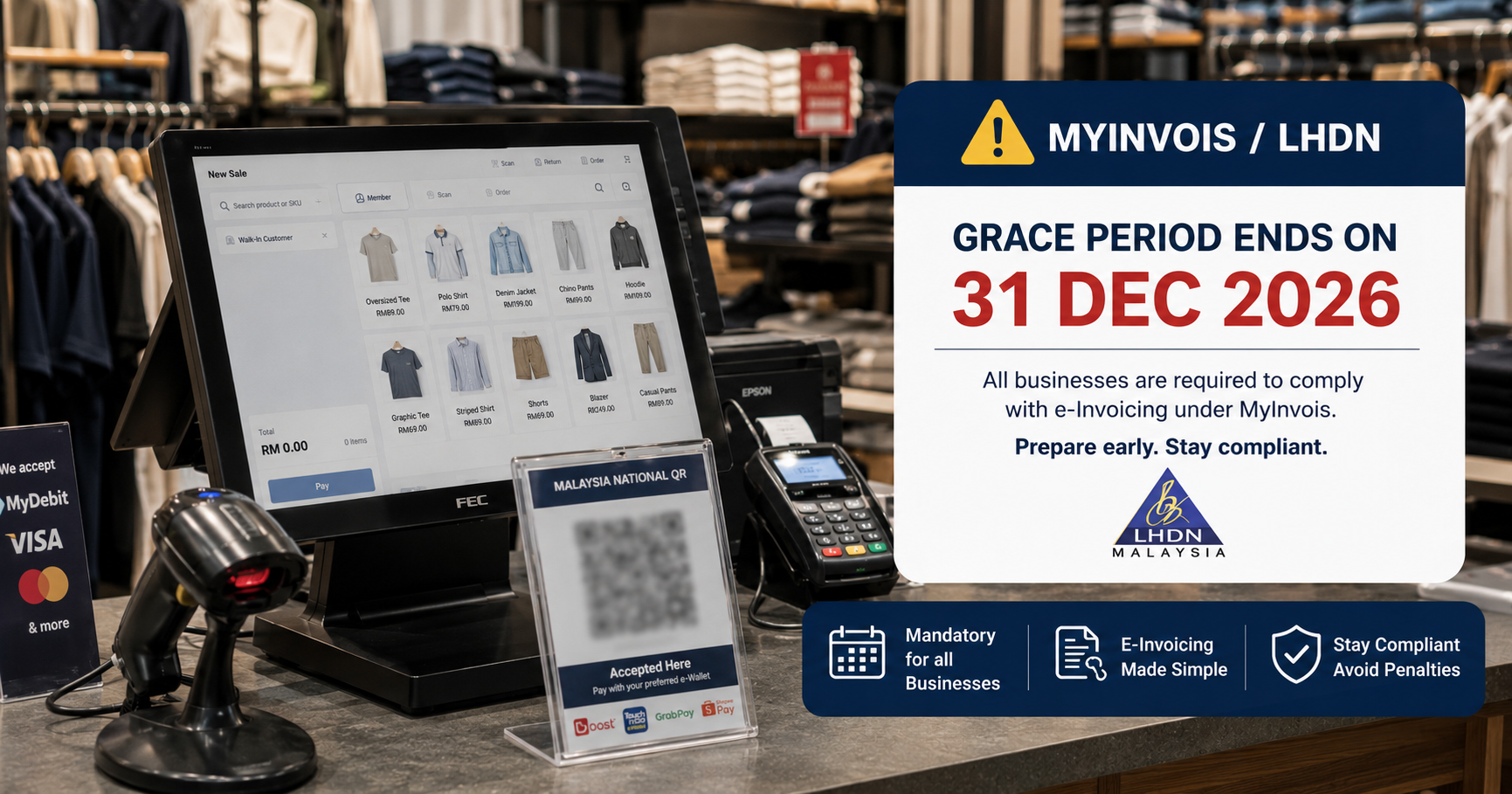
The grace period ends 31 December 2026. Most retailers are about to patch compliance onto broken systems — here’s the smarter move, and the RM50,000 tax deduction most don’t know exists.

On this page
You have less than six months.
On 7 July, PM Anwar announced an e-Invoice Special Voluntary Disclosure Programme (SVDP) running until end-December 2027: businesses that voluntarily review and correct their submitted — or unsubmitted — e-invoices won’t be penalised during this window.
Before you exhale — read that carefully. This is amendment relief for businesses already participating, not permission to ignore e-invoicing until 2028. The protection applies to voluntary corrections. What happens to a business LHDN finds non-compliant through audit — rather than through self-disclosure — has not been clarified, and full programme details are still pending on the LHDN e-invoice microsite.
The announcement also included genuinely good news: full capital allowance can now be claimed within one year for e-invoice-related spending on computer equipment and software development or modification. Stacked with the RM50,000 MSME tax deduction, the government is now subsidising a proper system upgrade from two directions.
Translation: the smart move hasn’t changed. Start submitting now, and use the SVDP window as your safety net for honest mistakes — not as an excuse to wait.
Source: PM’s Dewan Rakyat announcement, 7 July 2026 (reported by The Edge Malaysia).
If your retail business turns over RM1 million to RM5 million a year, the e-invoice mandate already applies to you — it became mandatory on 1 January 2026, and the 12-month relaxation period ends 31 December 2026. The penalties are real: RM200 to RM20,000 per invoice under Section 82C, up to six months’ imprisonment, and every non-compliant invoice counts as a separate offence. The new SVDP (above) shields voluntary corrections until end-2027 — but not, as far as anyone has been told, outright non-compliance found through audit.
The penalty exposure · Section 82C
RM200–RM20,000 per invoice · up to 6 months’ imprisonment · every non-compliant invoice is a separate offence.
Here’s the misconception costing retailers right now: many SME owners read January’s extension announcement as “I don’t need to do anything until 2027.” Wrong. The mandatory start date never moved. You’re supposed to be issuing e-invoices today. The extension only paused the penalties.
And here’s the part nobody’s telling you: the way most retailers are handling this deadline is about to become their second expensive technology mistake.
The First Mistake, Repeated
Think back to how you chose your current POS system. Probably under time pressure. Probably based on price. Probably from whichever vendor pitched hardest.
Now watch what’s happening with e-invoicing: retailers are under deadline pressure again, and vendors are pitching again — this time selling middleware, plugins, and “compliance modules” to bolt onto whatever system you already have.
Not every POS or accounting platform in the Malaysian market can generate LHDN-ready invoice formats or connect to the MyInvois API. For retailers with multiple outlets, marketplace sales, and TikTok Shop, manual submission through the free MyInvois portal cannot keep up with daily transaction volume once enforcement begins.
So what most retailers will do is buy the cheapest patch: middleware that connects their existing fragmented systems to MyInvois. It technically works. It also cements every existing problem — the POS that doesn’t sync with Shopee, the inventory count that’s wrong across channels, the customer data trapped in three separate systems — under a new layer of compliance plumbing that makes switching even harder later.
You’ll be compliant. You’ll also be stuck.
What the Deadline Actually Is: A Forced Systems Audit
The e-invoice mandate requires that all your sales channels — physical stores, online store, marketplaces, invoiced services — feed into a system that can submit validated invoices to LHDN, flag transactions of RM10,000+ that can’t be consolidated, meet the 7-day consolidated submission window, and store validated records for seven years.
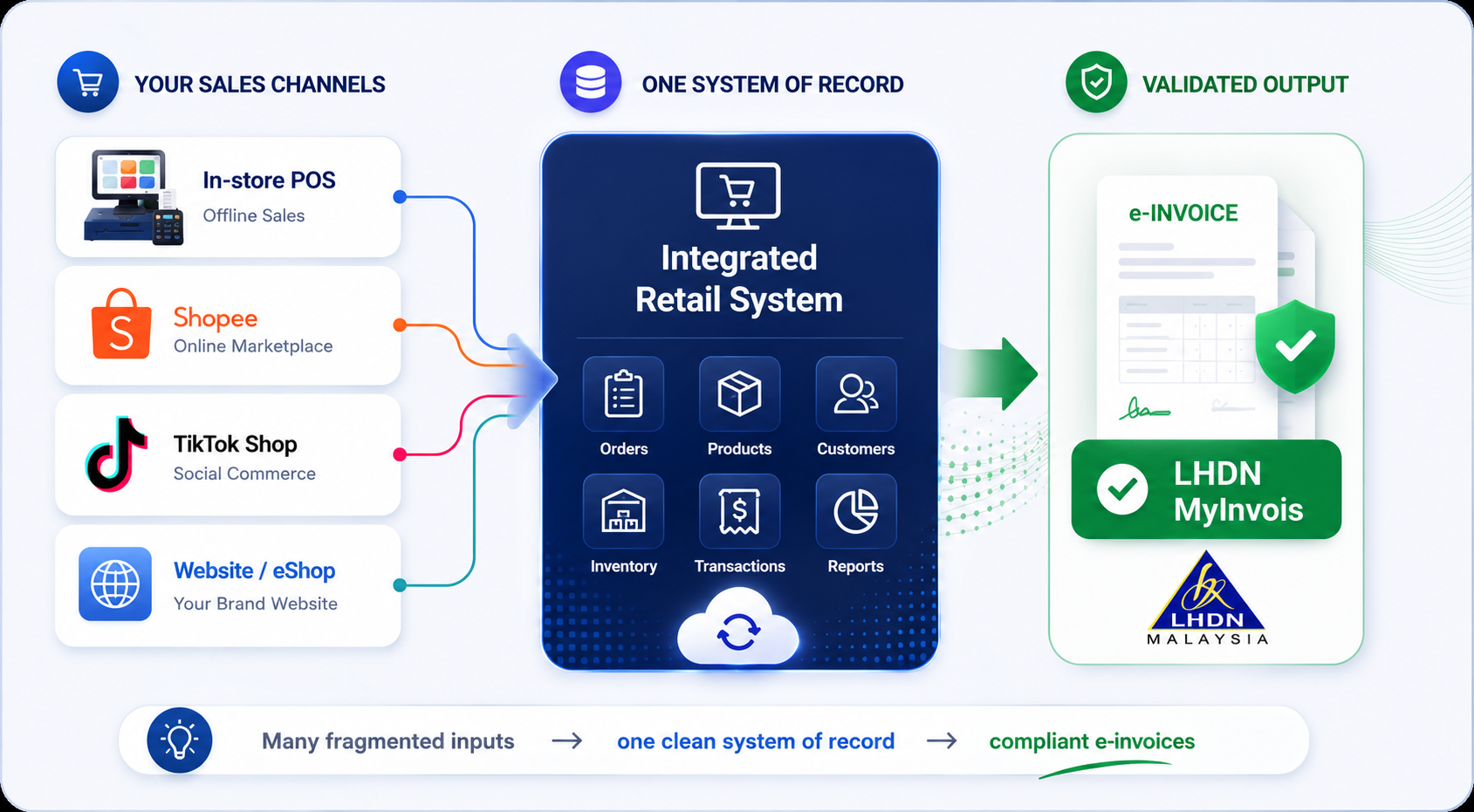
Read that list again. That’s not a compliance requirement. That’s a description of an integrated retail system — the thing you should have had anyway. It’s the deeper problem behind the compliance scramble.
“That’s not a compliance requirement. That’s a description of an integrated retail system — the thing you should have had anyway.”
Consolidated e-invoices for a month’s transactions must be submitted within seven calendar days after month-end. Detailed line-item descriptions with correct MSIC classification codes become mandatory once the relaxation period ends — “assorted goods” will no longer be acceptable.
For a fashion retailer with thousands of SKUs across sizes and colours, selling in-store and on three marketplaces, that requirement is impossible to meet manually and painful to meet with disconnected systems. It is only easy with one system of record.
This is why the retailers who treat the next six months as a compliance checkbox will spend money twice — once on middleware now, once on the real fix in 2027 or 2028. The ones who treat it as a forced systems audit will spend once.
The RM50,000 Most Retailers Are Leaving on the Table
MSME tax deduction
Up to RM50,000 / yearClaimable for qualifying e-invoice implementation and consultation costs — available until Year of Assessment 2027.
Most SME retailers don’t know this exists, because the vendors selling RM1/day middleware have no reason to tell you the government will effectively subsidise a proper systems upgrade.
If you were ever going to fix your retail stack — the inventory sync, the channel fragmentation, the missing customer data — this is the one window where a portion of that cost is tax-deductible and the deadline forces the decision anyway.
The Questions to Ask Before You Sign Anything
Before you buy any e-invoice solution — middleware, module, or new system — get answers to these:
Not a demo. A production client. Most resellers pitching compliance modules cannot produce one.
Consolidating a RM10,000+ transaction is a separate offence carrying the same RM200–RM20,000 fine.
A TikTok Shop return processed against physical-store inventory is exactly where fragmented systems produce invoice errors — and after the 72-hour cancellation window closes, corrections require credit or debit notes.
This question exposes whether you’re buying a patch or a foundation.
If the vendor doesn’t know what you’re talking about, that tells you how much they understand Malaysian SME retail.
Six Months Is Enough — If You Start With Diagnosis, Not Shopping
The wrong sequence: panic in November, buy whatever integrates fastest, stay fragmented for another five years.
The right sequence: audit which of your current systems can genuinely meet LHDN’s requirements, identify what’s worth keeping versus replacing, then implement — with the tax deduction claimed and the grace period as your testing runway. LHDN provides a sandbox environment for testing integrations before going live.
That first step — the honest audit — is exactly what no vendor will do for you, because every vendor’s audit concludes that you need their product. If a POS decision is part of that picture, here’s how to choose a compliant POS the right way.
Malaysia E-Invoicing: Quick Answers
When is the e-invoice deadline for Malaysian retailers?
For businesses with annual turnover of RM1 million to RM5 million, e-invoicing became mandatory on 1 January 2026, and the Phase 4 relaxation period ends 31 December 2026. On 7 July 2026 the government announced a Special Voluntary Disclosure Programme (SVDP) that shields voluntary e-invoice corrections from penalties until 31 December 2027 — but this is amendment relief for participating businesses, not a blanket deadline extension, and full details are still pending from LHDN.
What are the penalties for LHDN e-invoice non-compliance?
Under Section 82C of the Income Tax Act 1967, fines range from RM200 to RM20,000 per invoice, with possible imprisonment of up to six months, and each non-compliant invoice is treated as a separate offence. The July 2026 SVDP shields voluntary corrections until 31 December 2027, but has not been stated to cover non-compliance discovered through audit.
Is there a tax deduction for e-invoice implementation in Malaysia?
Yes. MSMEs can claim a tax deduction of up to RM50,000 per year of assessment for qualifying e-invoice implementation and consultation costs, available until Year of Assessment 2027.
Do I need a new POS system to comply with MyInvois?
Not always — but your systems must submit validated invoices to LHDN’s MyInvois, handle consolidated B2C invoices plus individual e-invoices for transactions of RM10,000 or more, and store records for seven years. Many older POS and accounting systems cannot, so auditing your current setup first is the smart move.
What is a consolidated e-invoice, and when is it due?
Retailers can consolidate B2C transactions into a single e-invoice submitted to LHDN within seven calendar days after month-end. Transactions of RM10,000 or more generally cannot be consolidated and require an individual e-invoice.
One Conversation Before You Buy Anything
Impact Crux is Malaysia’s independent retail technology advisor. We don’t sell POS systems, ERP, or e-invoice middleware. We help retailers figure out what their systems actually need to get properly e-invoice-ready — and whether this deadline is the moment to patch or to rebuild — then connect you with vetted, MyInvois-ready solutions that fit your specific setup.
The first conversation is free. No pitch.
Six months from now, every retailer in Malaysia will be compliant one way or another. The difference is whether you’ll be compliant on a system that finally works — or compliant on the same mess, now with government plumbing attached.
WhatsApp Ivan — 011-8888 1287Independent · We don’t sell POS, ERP or e-invoice software — we help you choose