
TikTok Shop vs Shopee Malaysia: Why the Same Strategy Doesn’t Work
Your TikTok Shop may not be selling because you’re running it like Shopee.

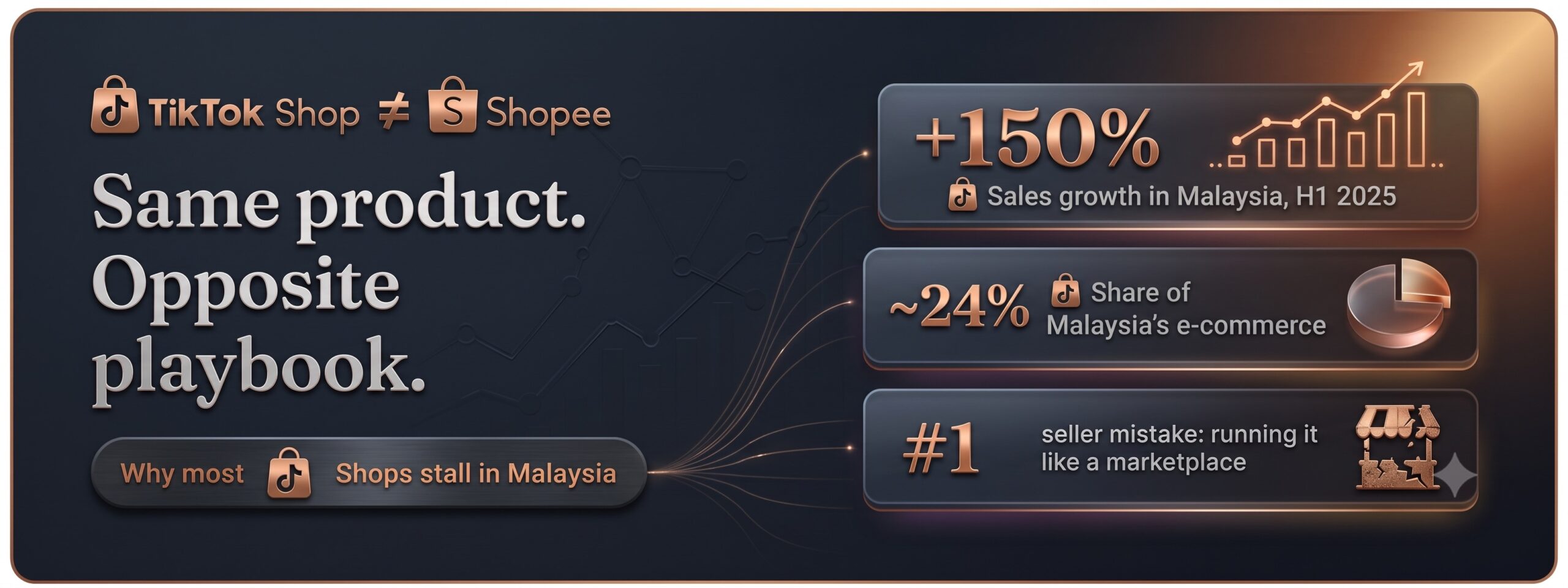
Malaysia social-commerce figures are industry estimates (Momentum Works, Cube Asia), 2025.
On this page
If you came here to find out which platform is better, the short answer is that they’re not competing for the same job.
Shopee is where Malaysians go when they already know what they want and are comparing price and reviews. TikTok Shop is where they find things they weren’t looking for. Sell the same way on both and one of them will quietly underperform — usually TikTok.
You did everything that worked on Shopee. Best products uploaded, tight titles, sharp prices, even a bit of ad spend. On TikTok Shop… nothing moved.
It’s the most common story in Malaysian e-commerce right now — and the reason usually isn’t your product, your price, or your luck. It’s that TikTok Shop looks like Shopee, so sellers run it like Shopee. They are not the same machine. In one important way, they’re the exact opposite.
The Trap: TikTok Shop Looks Exactly Like Shopee
Open a TikTok Shop seller centre and everything is familiar: product listings, a shopping cart, orders, shipping labels, a commission on each sale. Every instinct files it in the same drawer as Shopee and Lazada — a marketplace. So you do the marketplace things: optimise the listing, chase the keyword, set the price, run an ad, and wait for buyers to come searching.
On Shopee, they come. On TikTok, they never show up — because on TikTok, nobody is searching for your product in the first place.
The trap in one line
Shopee is a place people go to buy. TikTok is a place people go to watch — and occasionally buy what they’re shown. Same-looking shop, completely different buyer.
What is the difference between TikTok Shop and Shopee?
Shopee is a search-driven marketplace: shoppers arrive knowing what they want and compare listings on price, reviews and delivery. TikTok Shop is discovery-driven: shoppers aren’t searching, they’re scrolling, and the content does the selling before the listing does. The practical difference for a seller is that Shopee rewards listing optimisation while TikTok Shop rewards content and creators.
Should I sell on both TikTok Shop and Shopee?
For most Malaysian retailers, yes — but with different roles rather than the same catalogue and strategy on both. Use TikTok Shop to create demand for products that benefit from being shown, and Shopee to capture demand from shoppers already searching. Running an identical playbook on both is the most common reason one of them underperforms.
TikTok Shop vs Shopee Malaysia: Key Differences
Here’s the distinction the whole thing turns on — search versus discovery — and once you see it, you can’t unsee it.
| Shopee | TikTok Shop | |
|---|---|---|
| Buyer mindset | Already wants it | Wasn’t shopping at all |
| How they find you | Types a keyword, compares results | A video or live stops their scroll |
| Your job | Capture existing demand | Create demand from nothing |
| You win by | Ranking, reviews & price | Content, creators & live |
| The salesperson | Your listing | Your creators & affiliates |
| It feels like | A shelf | A show |
On Shopee, demand already exists and your job is to capture it. Someone wants an air fryer, searches “air fryer”, and picks from the results — so you win on ranking, reviews and price. On TikTok, demand doesn’t exist yet and your job is to create it. Nobody woke up wanting your air fryer; they’re watching a creator use it, and forty seconds later they want one. You win on content, creators and live.
“Shopee captures demand. TikTok creates it. Run the wrong playbook and you’re pouring water into a bucket with no bottom.”
Which is better for Malaysian sellers: TikTok Shop or Shopee?
Neither — and the question itself is the trap. The two platforms reward opposite behaviour, so the useful question is which job you’re hiring each one to do.
Shopee earns its keep when a customer already knows the product. They search, they compare, they read reviews, they buy the listing that wins on price and rating. If your product is known, replenishable, or competes on price, this is where the volume lives.
TikTok Shop earns its keep when the customer didn’t know your product existed. Demonstration, before-and-after, fit and texture — a creator using it in a way that makes sense of it. If your product needs explaining or showing, that explanation is the sale.
For most Malaysian retailers the answer ends up being both, with different roles. TikTok creates demand; Shopee captures it. The mistake that costs money is running one strategy across both — usually by copying the Shopee playbook onto TikTok and wondering why the listings sit still.
The cost side of the same decision
Here’s the part most strategy pieces skip — what each platform actually charges. Both now take a near-identical per-order platform fee, and Shopee has layered a commission increase on top through 2026.
TikTok Shop Malaysia introduced a Platform Support Fee of RM0.50 plus SST — RM0.54 per successfully delivered order — effective 15 February 2026, with exemptions for new sellers, qualifying SMEs, and essential categories such as fresh food, baking staples and approved textbooks. It applies regardless of order value, so on the orders it does cover it takes a larger bite out of small baskets. That sits on top of category commission and the transaction fee.
Shopee charges its own Platform Support Fee of RM0.50 plus 8% SST — the same RM0.54 per completed order — deducted before your sales proceeds are paid out, with similar exemptions for new sellers, essential-goods categories, and low-volume shops below Shopee’s monthly order and GMV thresholds.
On top of that sits category commission — and this is where “what does it cost” stops having one answer. Since Shopee’s 21 May 2026 update, commission is banded both by product cluster and by whether you’re on the Cashback Programme, running from around 0% on some essentials to the mid-teens for fashion and lifestyle. There’s no single number worth quoting; the only one that matters is the rate on your own category’s card in Seller Centre.
Cube Asia’s regional analysis puts effective take rates for Southeast Asian sellers as high as 20–25% of post-discount sales once programme fees and promotions are counted. Confirm your own category rate on each seller centre before you model margin — both platforms price by category and revise more often than most sellers check.
Why this belongs in a strategy article: fee increases punish the wrong strategy twice. A listing that would have converted on Shopee but sits still on TikTok isn’t just a slow listing — it’s carrying platform costs without the demand generation that would justify them. And neither fee buys back the customer data the platforms keep — that stays theirs, on both.
3 Signs You’re Running TikTok Shop Like Shopee
If your shop is quiet, you’ll almost certainly recognise at least one of these:
On Shopee the listing is the salesperson. On TikTok the listing is just the checkout — the selling happens in video and live before anyone reaches it. No content, no discovery, no traffic.
Shopee is a single storefront. TikTok’s reach comes from many creators and affiliates posting about you — not one polished brand page. One account is one small voice in a feed built for thousands.
On Shopee, ads buy search position. On TikTok, ads only scale content that’s already converting. Boost a weak video and you just spend faster — the creators and the content have to work first.
The Hidden Cost of Using the Wrong Playbook
Running TikTok like a marketplace doesn’t just fail to sell — it fails expensively. When you force traffic with paid ads instead of earning it with content, the platform’s fee structure works against you.
The margin math
TikTok Shop Malaysia takes a sales commission, an affiliate commission when a creator drives the order, and — since February 2026 — a Platform Support Fee of RM0.50 per order (RM0.54 with tax). On a RM5 item, that fee alone is ~10%. Pile paid ads on top to manufacture traffic, and a thin-margin, ad-driven Shopee approach quietly bleeds you dry.
The fix isn’t to cut the fees — you can’t. It’s to change where your traffic comes from. When creators and organic video drive most of your discovery, your cost per order falls and the platform’s economics start working for you instead of against you. That’s the entire point of the model TikTok is built on. (And note: TikTok also holds sellers to platform-native service standards — like a 12-hour response expectation — that a set-and-forget marketplace seller isn’t used to.)
And once those sales start flowing, there’s one more cost sellers forget: every TikTok Shop order has to land in your books correctly, because Malaysia’s e-invoice rules now apply to your online sales the same as your in-store ones. Your platform choice is also a systems choice.
How TikTok Shop Actually Wants to Be Sold
Stop treating it like a shelf and start treating it like a show, and the model gets simple. Four parts, working as one engine:

The TikTok Shop engine — miss one part and the rest stalls.
Content is the fuel: a steady stream of native video (not polished ads) that earns its way into the For You feed. Creators (CAP / MCN) mean you don’t have to be the star — you seed product to many creators who feature it believably to their own audiences. Affiliates (TAP) turn the best of those creators into commission-based sellers, so your reach scales without a bigger ad budget. Live selling then converts all that attention into orders in real time, where a large and growing share of TikTok Shop sales now happen.
That’s not four separate tactics — it’s one machine. Miss a part and the rest stalls. It is also, bluntly, a different skill set from running a Shopee store, which is why most brands don’t run it well in-house.
To be clear — this isn’t “quit Shopee”
Shopee still moves the most volume in Malaysia, and it’s where ready-to-buy searchers convert. The smart play is both: TikTok to create the demand, Shopee to capture the overflow. Just stop running them with the same playbook.
TikTok Shop vs Shopee: Quick Answers
Is TikTok Shop the same as Shopee?
No. Shopee is a search-led marketplace — buyers arrive already looking for a product and choose by ranking, reviews and price. TikTok Shop is a discovery-led platform — buyers are not searching; they find products through video, creators and live streams. Running a TikTok Shop with a Shopee-style ‘list it and wait’ approach is the most common reason a shop gets no sales.
Why is my TikTok Shop not getting sales?
The most common reason is treating it like a marketplace: uploading listings and running ads, but posting little native video and working with few or no creators. TikTok Shop’s traffic comes from content in the For You feed and from creators and affiliates, not from search. Without a steady stream of video and creator partnerships, listings stay invisible no matter how good the product or price.
Is TikTok Shop better than Shopee in Malaysia?
Neither is simply better — they do different jobs. Shopee still leads total sales volume in Malaysia and is strongest for search-driven, price-led buying. TikTok Shop is the fastest-growing platform — industry estimates put its Malaysian sales up roughly 150% in the first half of 2025 — and is strongest for discovery and trend-led categories like fashion, beauty and lifestyle. Many successful Malaysian sellers run both: TikTok to create demand, Shopee to capture it.
Do I need creators to succeed on TikTok Shop?
For most brands, yes. TikTok Shop is built around creators and affiliates who feature your product in native videos and live streams. Instead of relying only on a brand account, the sellers who scale seed products to many creators, turn the best performers into commission-based affiliates, and amplify the winning videos with paid ads. It is a different model from Shopee, where the listing itself does the selling.
How much does it cost to sell on TikTok Shop in Malaysia?
Beyond the product cost, TikTok Shop Malaysia charges a sales commission, an affiliate commission when a creator drives the order, and a Platform Support Fee of RM0.50 per order (RM0.54 with tax) introduced in February 2026 — a meaningful share of low-value orders. Because paid traffic is expensive, the platform rewards brands that let content and creators drive most of the customer acquisition rather than relying on ads alone.
Not sure which platform should carry which job?
That’s a strategy question before it’s an execution one — and it’s worth answering before you spend more on either platform. WhatsApp me and tell me what you sell and where it’s selling now.
WhatsApp Ivan — 011-8888 1287Independent · strategy first · no pitch if TikTok isn’t your answer
Running TikTok Shop Is a Full-Time Engine. Mplify Is That Engine.
Mplify is the TikTok commerce specialist we partner with — it runs the content, the creators (CAP / MCN), the affiliates (TAP) and the live, the whole machine — so your TikTok Shop actually sells instead of sitting there looking like a Shopee store that nobody visits. As Mplify’s growth partner, we get you set up with the right plan.
Disclosure: Mplify Media is one of Impact Crux’s vetted execution partners. We work closely with them on client campaigns, but they’re an independent company — if your situation calls for a different approach, we’ll tell you.
Is your TikTok Shop quiet? Let’s find out why.
Send us your shop and we’ll tell you straight where the machine is broken — content, creators, affiliates or live. The first read is free, and there’s no pitch if TikTok isn’t right for you.
WhatsApp Ivan — 011-8888 1287Content · Creators (CAP/MCN) · Affiliates (TAP) · Live · Malaysia-based
Sources