

“You Can’t Measure a Billboard.” In 2026, That Excuse Is Gone.
Malaysian outdoor advertising is growing, going digital, and — finally — measurable. Here’s what the numbers say, how a screen now drives the phone, and what to ask before you buy.

On this page
Every advertiser says it eventually: “Billboards look great — but I can’t measure them, so why spend the money?”
It’s the most reasonable objection in marketing. It’s also, in 2026, out of date. Out-of-home (OOH) advertising in Malaysia isn’t shrinking — it’s growing, shifting to digital LED screens, and closing the loop to the one device every customer carries: their phone.
Outdoor Isn’t Dying. It’s Going Digital.
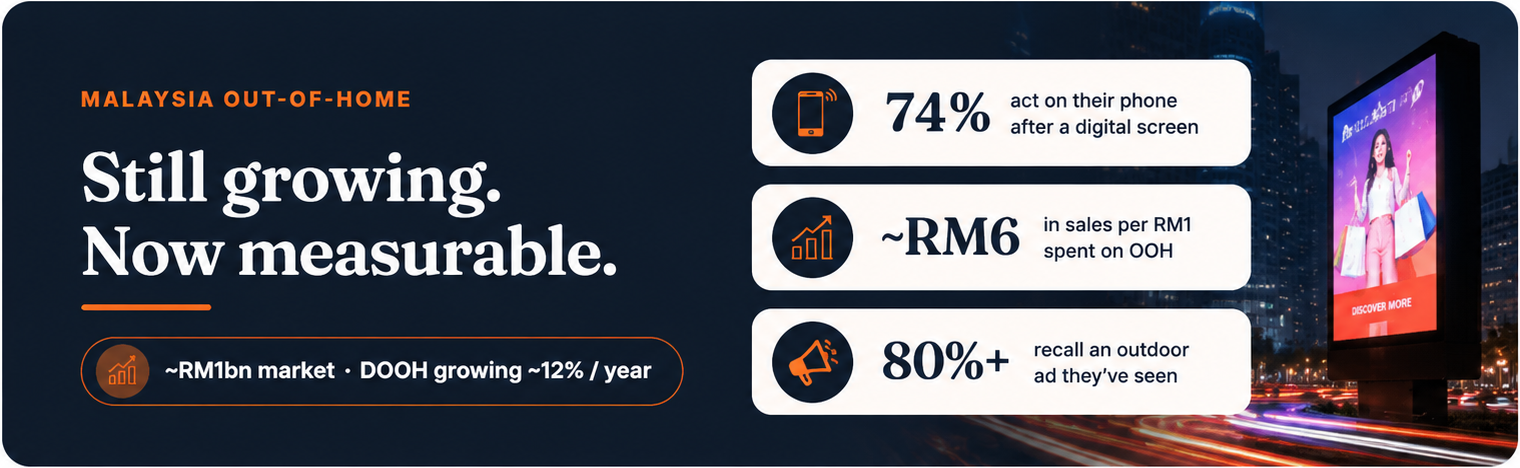
The Malaysian out-of-home market is worth about US$222 million in 2026 and is projected to reach US$294 million by 2031 (Mordor Intelligence). The part pulling it up isn’t vinyl — it’s screens. Digital out-of-home (DOOH) is the fastest-growing format, expanding at ~10.75% a year — nearly double the overall market’s 5.76%.
And the single biggest category buying outdoor in Malaysia? Retail and consumer goods — 29.35% of all OOH spend in 2025 (Mordor Intelligence), the largest vertical of the lot. Which is exactly why a retail advisor is writing about billboards: your customers, and your competitors, are already on those screens.
The Numbers That Surprise Advertisers
The “billboards are old-school” instinct doesn’t survive contact with the data:
What the research shows
80%+ of people recall an out-of-home ad they’ve seen · 88% saw one in the last 30 days · every US$1 spent on OOH returns an average of US$5.97 in sales (OAAA) · and OOH lifts digital-search effectiveness by 40%+.
It’s also a multiplier, not a silo. The same OAAA/Benchmarketing research found out-of-home lifts the effectiveness of digital search by more than 40% — meaning the search, social and e-commerce budgets you already run work harder when a physical screen reinforces the same message.
Your Billboard Now Talks to Their Phone
Here’s the shift that kills the “can’t measure it” objection. About 74% of people take an action on their phone after seeing a digital screen — 44% search for the advertiser, 38% visit the website, 30% check social. The screen and the phone are no longer two separate campaigns. They’re one.
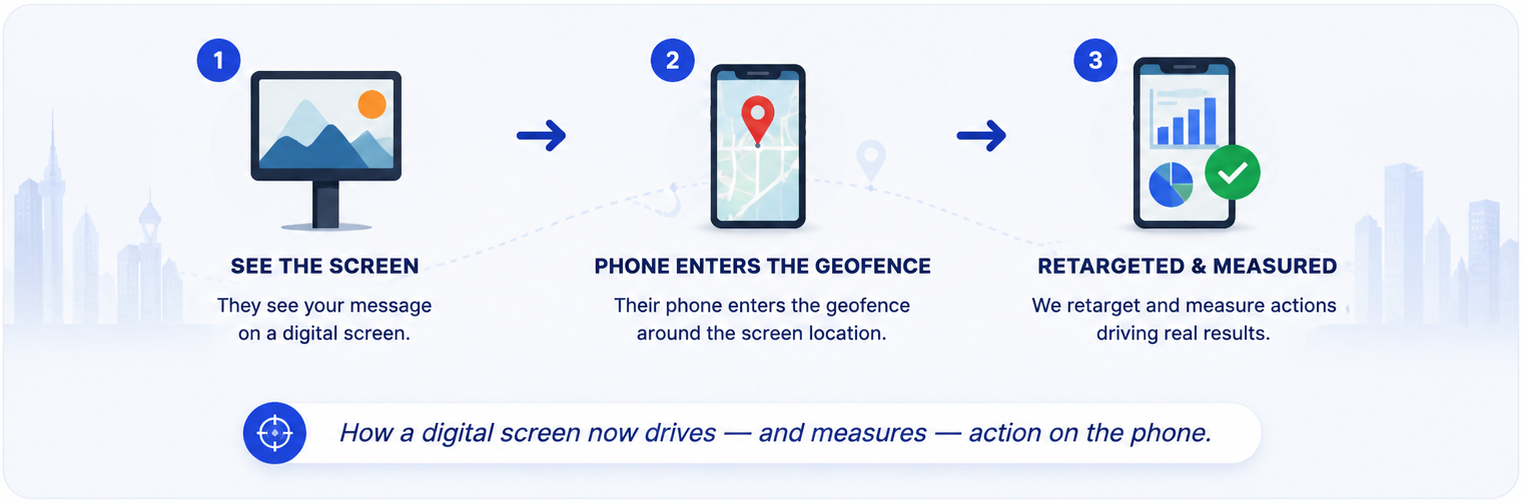
Three mechanics make it real:
Geofencing + retargeting. When a phone enters the area around a screen, its anonymised ad ID can join a retargeting pool — so the commuter who saw your billboard sees a follow-up on their phone later. That follow-up lifts conversions by roughly 20%.
QR codes. A code on the screen turns “I saw it” into a trackable scan → offer, website, or store.
Foot-traffic attribution. Anonymised location data links “saw the screen” to “walked into the shop.”
“The billboard didn’t disappear. It moved into your customer’s pocket.”
And this isn’t guesswork any more: the IAB and MRC published DOOH measurement standards in 2025, giving the whole approach a defined methodology.
Static vs Digital LED: Why the Screens Are Winning
This is the other half of the story — and where a lot of budget is quietly being wasted on the wrong format.
Static vinyl vs digital LED
Static = one fixed creative, one advertiser, no changes until the next print. Digital LED = rotate multiple creatives, change the message by time of day, update instantly, run dynamic content (countdowns, weather, live offers), share the panel to lower the entry cost — and plug into all the measurement above.
That flexibility is exactly why LED is now the majority of new installs — and why more Malaysian brands are asking for screens, not vinyl. A static board is a poster. A digital panel is a channel. And if the screens you’re considering are your own — in-store or storefront rather than rented roadside — that’s a different purchase entirely: what Watsons and AEON know about retail LED.
What to Ask Before You Buy Outdoor Media
Before you commit to any billboard, screen, or “package deal,” get straight answers to these:
Not “it’s a busy road.” Real numbers on volume and who passes it.
A screen split 12 ways is very different from one split 4 ways.
If the answer is “you can’t,” you’re buying a poster, not a campaign.
This is where a screen becomes a full-funnel channel.
The difference between a clean campaign and a dark screen no one fixes.
Outdoor Advertising in Malaysia: Quick Answers
Is billboard advertising still effective in 2026?
Yes. Global studies show more than 80% of people recall an out-of-home ad they’ve seen, and every US$1 spent on out-of-home generates an average of US$5.97 in sales (OAAA/Benchmarketing research). Digital out-of-home (DOOH) is the fastest-growing ad format, and in Malaysia the out-of-home market is projected to reach about US$294 million by 2031 (Mordor Intelligence).
Can outdoor advertising be measured?
Yes. Digital out-of-home can be measured using QR codes on the screen, geofencing with mobile retargeting, and anonymised foot-traffic attribution that links ad exposure to store visits. The IAB and MRC published DOOH measurement standards in 2025, so it is now a defined methodology rather than guesswork.
What is the difference between a static billboard and a digital (LED) billboard?
A static billboard shows one fixed creative for the whole booking. A digital LED billboard can rotate multiple creatives, change the message by time of day, update instantly, run dynamic content, and be measured and linked to mobile — which is why LED now makes up the majority of new billboard installations in Malaysia.
How does outdoor advertising drive online or mobile action?
Research shows about 74% of people take an action on their phone after seeing a digital screen — searching for the advertiser, visiting the website, or checking social media. Advertisers connect the screen to the phone using QR codes, geofenced mobile retargeting, and location-based attribution.
How much does outdoor advertising cost in Malaysia?
It varies widely by location, format (static vs digital LED), how many advertisers share a digital screen’s loop, and campaign duration — a small-town static board and a prime Kuala Lumpur LED screen are very different investments. The right approach is to match the location and format to your audience and budget rather than simply chasing the cheapest board.
One Team for the Screen and the Strategy
Most brands stitch this together the hard way — a media agency to plan it, a separate screen vendor, and an installer who’s never spoken to either. Impact Crux sits on your side of the table: we help you choose the right location and format, then connect you with vetted media owners and LED suppliers — and negotiate on your side, not theirs. Here’s how that advisory works. We don’t own the boards, so our only incentive is the placement that actually performs for you.
A note on how we work
Impact Crux doesn’t own billboards, LED panels, or media inventory. We work closely with vetted media partners and are compensated for successful placements — which means our incentive is finding you the placement that performs, not filling a specific board.
Planning an outdoor campaign?
Let’s map it to your audience and budget first — then get you the right board through the right partner. The first conversation is free — no pitch, just a straight read on whether outdoor is worth it for you.
WhatsApp Ivan — 011-8888 1287Independent media advice · Vetted partners · Malaysia-based